

News
Robotaxi hits the streets of Bratislava: Autonomous cars get the green light in Slovakia
The rules for testing and operating automated vehicles in Slovakia are changing. The approved amendment defines more precisely who may operate a vehicle, who will supervise it and who may intervene if necessary. Thanks to this amendment, we at DiusAi can take our testing of autonomous vehicles further.
The law sets the rules, but the safety and readiness of the technology have to be proven in practice. The next phases must therefore build on the results and data we gather during the individual phases of pilot testing. So which phase are we in right now?
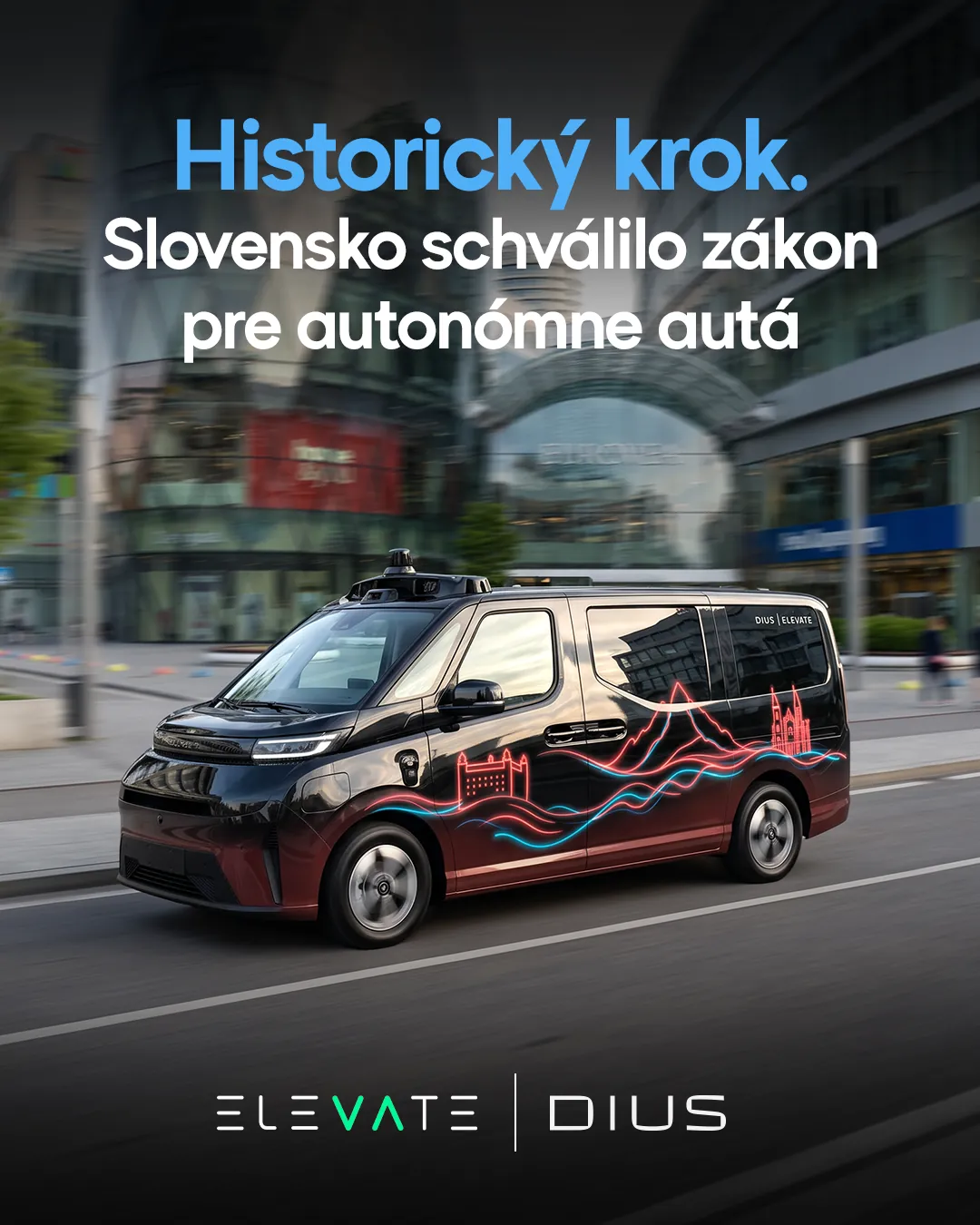
The autonomous vehicles that will operate in Slovakia thanks to the ELEVATE Slovakia initiative are going through the testing process one by one.
The first vehicle to have already completed test drives on a closed circuit is the Robotaxi. Over the coming weeks, as part of the approved trial operation, it will be tested in real traffic in Bratislava, with safety drivers on board.
The Robosweeper, which will help cities clean their streets, is starting the first phase of testing on a closed circuit. The RoboVan autonomous vehicle, which will complement courier services in cities and in harder-to-reach areas, is at the same stage.
Two projects, two different experiences
At DiusAi, we are developing autonomous mobility in two ways.
The first is our cooperation with WeRide within the ELEVATE Slovakia platform. WeRide brings technology that has already been tested and deployed in several countries. Its portfolio includes autonomous taxis, buses, logistics and municipal vehicles.
The second project is DIUS LAB, where our colleagues are developing their own autonomous driving system on a Volkswagen ID.7.
The development includes integrating cameras, radars, LiDARs, localisation systems and software that processes information about the surroundings. The vehicle must be able to recognise a pedestrian, a cyclist, road signs or an obstacle. It then has to assess the situation, plan its next move and carry it out safely.
And it has to manage this not only in ideal conditions. That is why the system is first tested in the lab. This is followed by data collection during manual driving, map creation and trials in a closed environment. Testing on public roads can only follow once the legislative and safety requirements have been met, and only with a safety driver present.
WeRide and DIUS LAB are therefore not two identical projects.
Our partnership with WeRide gives us experience with technology that has already proven itself in real-world operation. DIUS LAB allows us to build our own team, understand the entire development process and create technological know-how right here in Slovakia.
That is exactly why the approval of the amendment matters for our projects too. We already have the technology, the expert team and our first testing experience. The amendment adds an important missing piece, without which it is not possible to move systematically from controlled pilot projects to the next stages. Some details of the actual operation will still be specified in an implementing regulation of the Ministry of Transport of the Slovak Republic, which is currently being prepared.
For us, 1 December 2026 is therefore not the date we start. It is the date from which we will be able to continue our existing work in a more clearly defined legal environment.